
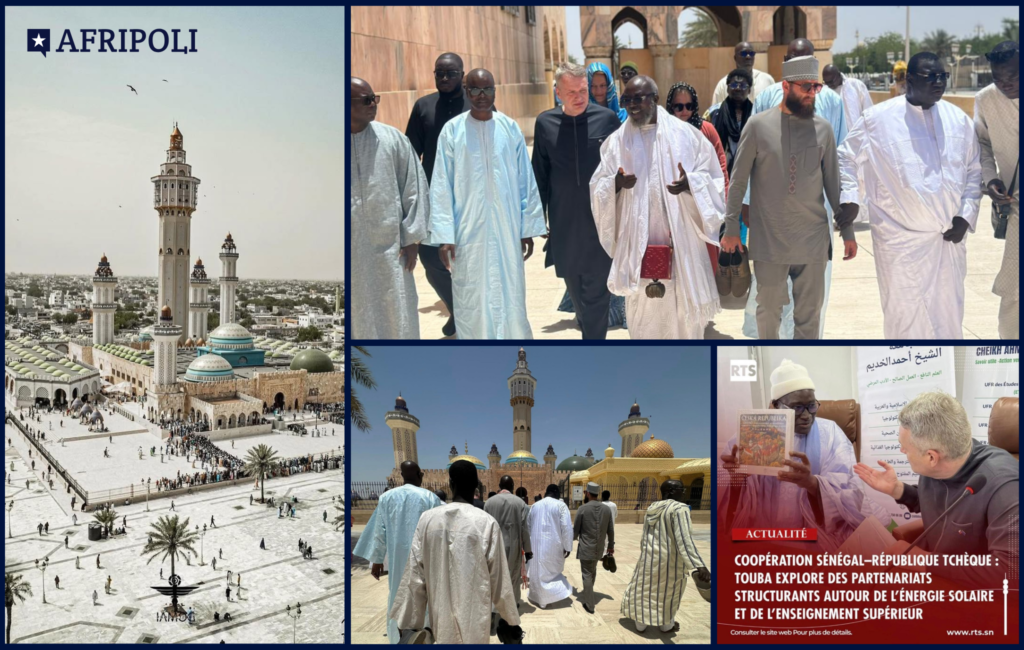
Touba is the second-largest city in Senegal, the spiritual capital of the Mouride brotherhood, and one of the few places in West Africa where a city of more than a million people manages much of its own education, infrastructure and public services independently of the state. For partners willing to engage on its terms, it is also one of the most interesting places in the region to work.
In late April, Afripoli visited Touba alongside a Czech delegation led by H.E. Pavel Procházka, Ambassador of the Czech Republic to Senegal. The visit was part of Afripoli’s ongoing work in Senegal on sustainable energy and Czech-Senegalese partnerships.
Inside Afripoli’s visit to Touba — the audience with the Grand Khalife General of the Mourides, the Great Mosque, and the Cheikh Ahmadou Khadim Complex.
Solar power for Touba’s mosques, clinics and public services
The substantive core of the visit was energy. Discussions centred on solar solutions for key public infrastructure in Touba — the Great Mosque, health centres and other facilities serving the wider community. Rising energy costs are a growing burden on these institutions, and the city’s leadership is actively looking for partners able to deliver reliable, long-term solutions.
This work fits within a broader national context. Through its Just Energy Transition Partnership, signed in 2023 with France, Germany, the European Union, the United Kingdom and Canada, Senegal aims to raise the share of renewables in its installed electricity capacity to 40% by 2030. The country has recently launched its formal Investment Plan to deliver on that goal, as part of its National Development Strategy 2025–2029. Afripoli’s role is to help connect that transition with concrete projects on the ground — working with local partners on solutions that can support social infrastructure and be maintained over time.
Energy projects open the door to academic and agricultural cooperation
The delegation was received in audience by Serigne Mountakha Mbacké, the Grand Khalife General of the Mourides — a meeting of considerable weight, given the Khalife’s role as the highest authority within the brotherhood. The exchange focused on the direction of Czech-Senegalese cooperation and on shared interest in strengthening Touba’s energy autonomy.
At the Cheikh Ahmadou Khadim Complex, discussions focused on possible links with Czech universities, particularly in agriculture, agri-food systems and tropical and subtropical farming.
These conversations grow naturally out of the energy work. Reliable power is what makes irrigation pumps run, food processing viable, clinics functional and schools usable after dark. Once that base is in place, the question quickly becomes what to build on top of it — and that is where applied research, training and university partnerships come in. For Czech institutions, this opens a practical entry point into Senegal that goes beyond technology supply.
Senegal’s energy ambition meets Czech expertise where it matters
Senegal has set itself one of the more ambitious renewable energy targets in West Africa, and it is now looking for partners able to help deliver. Czech know-how in solar technology, water management, agri-tech and applied education fits this moment well — and the Czech Republic’s 2022 Africa strategy identifies Senegal as one of its key bilateral partners in sub-Saharan Africa.
Translating that alignment into projects that actually get built requires people who understand both contexts: who know the technologies and the institutions in the Czech Republic, and who have the relationships and the patience to work effectively in Senegal.
The work in Touba is being driven forward by Afripoli, and we are doing it with a set of partners we intend to keep building with. The Embassy of the Czech Republic in Dakar has been a constructive counterpart in shaping Czech-Senegalese cooperation on the ground. The Municipality of Touba and Mayor Abdou Lahad Ka opened the door to a serious conversation with the city’s institutions. These are the relationships we plan to take forward — because what we are building in Touba is meant to last.